
Himalaya Cystone
Benefits of Cystone: Urinary Tract Health, Kidney Health
 Himalaya Herbals Cystone
60 Tablets per Bottle
FREE Shipping Worldwide!
| 1 Bottle $7.99 | |
| 3 Bottles $21.99 | |
| 6 Bottles $39.99 |
Customers also purchased

Punarnava
Kidney and Liver Tonic
Cystone is an ayurvedic formulation of herbs and minerals. Cystone naturally promotes a healthy urinary tract and helps maintain normal urine composition and mucosal integrity. It is a natural aid in maintaining healthy water management and relieves temporary water - weight gain.
As a dietary supplement Cystone assists the kidneys and urinary tract in normal functions. It provides normal absorption and utilization for an overall healthy urinary tract.
How does Cystone work?
Cystone prevents supersaturation of lithogenic substances that promote the formation of calculi. It controls oxamide absorption from the intestine and maintains the crystalloid-colloid balance. It helps to disintegrate urinary calculi by its actions on mucin which binds particles together and flushes out particles with urinary flow.What are the benefits of Cystone?
- Cystone helps to flush the urinary tract safely and gently
- Cystone maintains normal urine composition
- Cystone promotes normal kidney health
- Cystone promotes normal urinary tract health
- Cystone soothes the urinary tract using systemic flushing
- Cystone supports normal equilibrium of pH (acidity or alkaline) in the bladder
- Helps in supporting the immune system
- Helps to prevent urinary stones
What are the ingredients in Cystone?Ingredients (Per Tablet):
|
Herb & Mineral Powders and Extracts in Cystone |
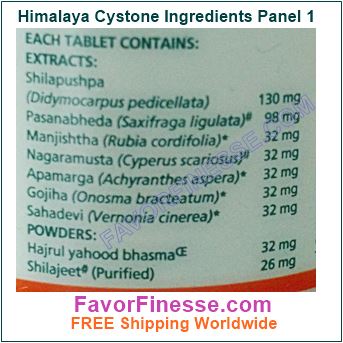

Cystone Ingredients in Ayurveda
In India several indigenous herbs for maintaining urinary tract health have been in vogue since ancient times [Charak (600 BC) and Sushruta (1000 BC)]. These herbs include Didymocarpus pedicellata (Patharphor), Pasanabheda, Dolichos biflorus (Kulath), Rubia cordifolia (Manjit), Crataeva nurvala (Varuna) and Tamarindus indica (Tamarind). Cystone, manufactured by The Himalaya Drug Co., is a formulation of such herbs.How do the herbs and minerals in Cystone promote urinary tract health?
- Shilapushpa (Didymocarpus pedicellata) which literally means "Stone flower" is widely used in traditional Indian medicine for renal issues. In research studies the herb extract
was shown to provide antioxidant activity and protect against renal oxidation.
Studies have shown that a preparation containing Didymocarpus pedicellata along with other herbal agents induces size reduction and clearance of renal and ureteral stones 1
- Pasanabheda (Saxifraga ligulata) - Pasanabheda literally translates to "that which breaks stones" in Sanskrit. Saxifraga in Latin means "stone-breaker". This herb has been used in Ayurveda to maintain renal health and for protecting against vesical calculi. It is known in Ayurveda for its ability to dissolve stones.
In a 2017 study on rats, it was found that an extract of Saxifraga ligulata also called Bergenia ligulata resulted in decrease in serum and urine markers. Calcium oxalate deposits were also lower in rats treated with this herb extract. It also prevented damage to kidneys.2
- Manjistha (Rubia cordifolia) posseses detoxifying and diuretic properties that help to maintain the health of the urinary tract. It is very well known as a blood purifying herb. It is considerd to have anti-fungal properties.
Studies have shown that the phytonutrients in plants like Rubia cordifolia help in the management of urolithiasis due to their diuretic, antispasmodic, and antioxidant activity. They also inhibit aggregation of crystals3
- Umbrella's edge or Nagarmusta(Cyperus scariosus) is used in traditional Ayurvedic medicine to reduce swelling and is a detoxifying agent that cleanses the kidneys, pancreas, liver, spleen and uterus
A study also showed that Cyperus scariosus in combination had a salutary effect on urinary functions in women. It was given in combination with with Boswellia serrata and pelvic floor muscle training to reduce urine leakage4
- Prickly chaff flower or Apamarga (Achyranthes aspera) helps to break up calculi, cleanse the blood and also helps reduce swelling of internal organs. It is also anti-pyretic in nature
A survey in India showed that this herb is considered very important by traditional healers for gynecological and urinary tract health5
- Sedge or Gojiha (Onosma bracteatum)is considered beneficial for the kidneys, prevention of kidney stones and pulmonary system
It belongs to the genus Onosma L. and is considered to have laxative, anthelmintic and anti-dotal effects.6
- Purple fleabane or Sahadevi (Vernonia Cinerea) is helpful in reducing bladder spasms, purifiying blood and normalizing urinary flow
A study on rats showed that it helps to reduce formation of calcium, oxalates, and phosphates which lead to stone formation.7
- Hajrul yahood bhasma (Lapis judaicus)is a fossilized mineral powder that contains silicate of lime. It has diuretic and lithontriptic properties and helps normal flushing of urine.
Practitioners of traditional medicine systems such as Unani and Ayurvedic have used it since ancient times for kidney and bladder stones due to its antilithiatic8

- Shilajit which is a mineral supports the bladder. It serves as a tonic for the urinary tract and kidneys. It helps in promoting a smooth urine flow and also prevents urinary urgency. A study published in Russian journal showed that Shilajit was beneficial for blockages in urinary bladder.9
- Vanatulasi (Ocimum basilicum) - also known as Sweet Basil this plant is known for various benefits in traditional healing methods. It is considered beneficial for kidneys. The essential oil has been shown to have
bactericidal and anti-fungal activity10
- Gokshura (Tribulus terrestris) - is considered very beneficial for the urogenital system. It has a cytoprotective protein that helps to protect cells from harmful agents. Studies have also shown that it inhibits stone formation.11
- Lajjalu (Mimosa pudica) - This curious plant has little leaflets that fold up and droop upon being touched. Hence the Indian name "lajjalu" meaning "bashful". It has soothing, cooling diuretic properties.
It has traditionally been used for various conditions including for the uro-genital tract, pile mass, and for relieving pressure on veins and sinuses. 12
- Kulattha (Dolichos biflorus) - Rich in protein, iron and other minerals, Horse gram is said to have anti-oxidant properties. In Ayurveda, it is used for renal stones. Complex sugars present in this herb have shown antimicrobial activity13
- Joratoota (Equisetum arvense) - Also known as Horsetail, this herb is has been used traditionally for fluid retention, kidney and bladder stones and to control urine flow. Its Indian name Joratoota literally translating to "that which fixes what is broken" refers to its benefits for healing bones. A 2018 study showed it to have anti-bacterial and anti-oxidant activity14
- Shaka seeds (Tectona grandis) - These seeds are considered to have diuretic properties and help in micturition.
What are the directions for taking Cystone?
Take 2 tablets twice daily with meals. May be increased to 2 tablets three times daily, if required.Allow several weeks for benefits. The use of natural products provides progressive but long-lasting results.
Cystone tablets size, dimensions, color
 Himalaya Cystone Tablets are approximately 11mm in diameter and 2mm in thickness, yellow in color. They are easy to swallow
Does Cystone have any side effects?
Cystone does not produce any side effects, if taken as per the prescribed dosage.Does Cystone have any contraindications and drug interactions?
Special precautions are to be exercised in patients with kidney, liver and heart impairment who are taking prescription medicines. Since Cystone is also meant to help kidney and liver functions, you should inform your physician as medicine dosage may need to be monitoredNo clinically or biochemically significant drug interactions have been reported with the use of Cystone.

Cystone from Himalaya Herbals
Cystone is a product from the renowned Himalaya Herbals brand endorsed by over 250,000 doctors worldwide and used by customers in over 60 countries. Himalaya Herbals products have been researched clinically and standardized to guarantee bioequivalence. Bioequivalence refers to ensuring that the product on the market is equivalent to the one on which clinical trials were successfully conducted. Himalaya Herbal Healthcare uses chromatographic fingerprinting, one of the most sophisticated standardization techniques, to ensure consistent quality and performanceCystone Research and Clinical Studies
Cystone has been subjected to various clinical studies to establish its benefits for the urinary tract and kidneys. Various research studies on cystone have been documented in medical journals.References:
Himalaya Herbals CompanyPub Med
1. Archivio Italiano di Urologia Andrologia. 2016 Mar 31;88(1):38-46. doi: 10.4081/aiua.2016.1.38.
Herbal medicines for urinary stone treatment. A systematic review.
Monti E1, Trinchieri A, Magri V, Cleves A, Perletti G.
2.Biomed Research International. 2017;2017:1969525. doi: 10.1155/2017/1969525. Epub 2017 Mar 2.
Antiurolithiasis Activity of Bioactivity Guided Fraction of Bergenia ligulata against Ethylene Glycol Induced Renal Calculi in Rat.
Sharma I, Khan W, Parveen R, Alam MJ, Ahmad I, Ansari MH, Ahmad S.
3. International Journal of Molecular Science. 2018 Mar 7;19(3). pii: E765. doi: 10.3390/ijms19030765.
Dietary Plants for the Prevention and Management of Kidney Stones: Preclinical and Clinical Evidence and Molecular Mechanisms.
Nirumand MC, Hajialyani M, Rahimi R, Farzaei MH, Zingue S, Nabavi SM, Bishayee A.
4. Complementary Therapies in Clinical Practice. 2014 Nov;20(4):230-6. doi: 10.1016/j.ctcp.2014.08.003. Epub 2014 Sep 4.
Efficacy of Boswellia serrata L. and Cyperus scariosus L. plus pelvic floor muscle training in stress incontinence in women of reproductive age.
Arkalgud Rangaswamy P, Sultana A, Rahman K, Nagapattinam S.
5. Journal of Traditional and Complementary Medicine. 2017 Jul 4;8(2):308-323. doi: 10.1016/j.jtcme.2017.06.009. eCollection 2018 Apr.
Traditional plants used for the treatment of gynaecological disorders in Vedaranyam taluk, South India - An ethnomedicinal survey.
Balamurugan S, Vijayakumar S, Prabhu S, Morvin Yabesh JE.
6.Pharmacognosy Reviews 2013 Jul-Dec; 7(14): 140–151. doi: 10.4103/0973-7847.120513 PMCID: PMC3841992 PMID: 24347922
Onosma L.: A review of phytochemistry and ethnopharmacology
Neeraj Kumar, Rajnish Kumar, and Kamal Kishore1
7. Indian Journal of Pharmacology. 2016 Jul-Aug; 48(4): 434–440. doi: 10.4103/0253-7613.186211 PMCID: PMC4980934 PMID: 27756957
Effect of hydro-alcoholic extract of Vernonia cinerea Less. against ethylene glycol-induced urolithiasis in rats
Ravindra D. Hiremath and Sunil S. Jalalpure1,
8. Journal of Ethnopharmacology 2018 May 5;222:165-170. doi: 10.1016/j.jep.2018.04.047.
Hajrul yahood (Lapis judaicus): An important mineral drug of Unani system of medicine for the management of urolithiasis.
Makbul SAA, Jahan N, Ahmad G.
9. Likars'ka Sprava. 1997 Nov-Dec;(6):129-32.
[The treatment of benign prostatic hyperplasia using the Mumie-Vitas preparation.
Andriukhova NN.
10. Ancient Science of Life. 2014 Jan;33(3):151-6. doi: 10.4103/0257-7941.144618.
Chemical composition and antimicrobial activity of the essential oil of Ocimum basilicum L. (sweet basil) from Western Ghats of North West Karnataka, India.
Joshi RK.
11. PLoS One. 2017 Aug 28;12(8):e0183218. doi: 10.1371/journal.pone.0183218. eCollection 2017.
Response surface methodology based extraction of Tribulus terrestris leads to an upsurge of antilithiatic potential by inhibition of calcium oxalate crystallization processes.
Kaushik J, Tandon S, Gupta V, Nayyar J, Singla SK, Tandon C.
12. Pharmacognosy Review. 2012 Jul-Dec; 6(12): 115–124. doi: 10.4103/0973-7847.99945 PMCID: PMC3459453 PMID: 23055637
Mimosa pudica L. (Laajvanti): An overview
Hafsa Ahmad, Sakshi Sehgal, Anurag Mishra, and Rajiv Gupta
13. Chemistry Central Journal 2017; 11: 118. Published online 2017 Nov 21. doi: 10.1186/s13065-017-0349-2 PMCID: PMC5696267 PMID: 29159657
Polysaccharides from Dolichos biflorus Linn and Trachyspermum ammi Linn seeds: isolation, characterization and remarkable antimicrobial activity
Manojit Ghosh, Rupam Kumar Bhunia, Jhuma Ganguly,and Bimal K. Banik
14.Oxidative Medicine and Cellular Longevity 2018 Feb 14;2018:3060525. doi: 10.1155/2018/3060525. eCollection 2018.
Equisetum arvense L. Extract Induces Antibacterial Activity and Modulates Oxidative Stress, Inflammation, and Apoptosis in Endothelial Vascular Cells Exposed to Hyperosmotic Stress.
Pallag A1, Filip GA2, Olteanu D2, Clichici S2, Baldea I2, Jurca T1, Micle O3, Vicaş L1, Marian E1, Soriţău O4, Cenariu M5, Mureşan M3.
Other Products for Urinary and Reproductive Health


Blood Sugar
Cholesterol
Heart Health, Blood Pressure & Circulation
Rectal and Vein Health
Joint Care
Detoxification & Cleansing
Digestive Tract Health
Skin Health
Reproductive Health & Fertility
Female Health, Fertility & Hormonal Balance
Male Fertility
Prostate Health
Kidney & Urinary Tract Health
Stress Relief, Sleep, Relaxation
Brain Functions, Memory
Anti-Aging, Immunity, Rejuvenation


Checks/Money Orders in US$
Home | About Us | Contact Us | Customer Service | FAQs | Shipping | Promotions | Articles | Blog | Testimonials | Newsletters | SHOP OUR INSTAGRAM | Terms of Service | Articulos - En Espanol
Copyright © 2007-2021 FavorFinesse.com. All rights reserved. Designated trademarks and brands are the property of their respective owners. We are not in any way affiliated with the manufacturers of the products and have not evaluated products or claims made about products on or through this site
Disclaimer: The products and the claims made about specific products on or through this site have not been evaluated by the United States Food and Drug Administration. These products are not intended to diagnose, treat, cure or prevent any disease. The information provided on this site is for informational purposes only and is not intended as a substitute for advice from your physician or other health care professional or any information contained on or in any product label or packaging. The information on this site should not be used for diagnosis or treatment of any health problem or for prescription of any medication or other treatment. Please view our full Terms Of Service Agreement for more information and the terms and conditions governing your use of this site.
Prices and promotions are subject to change without notice.

Do not copy content from the page. Plagiarism will be detected by Copyscape.
 Secure Shopping
Premium Herbal Ayurvedic Products
Secure Shopping
Premium Herbal Ayurvedic Products
LOWEST PRICES ONLINE
FREE SHIPPING WORLDWIDE


Liv.52 World's #1
Liver Care Formula
- Abana...Cardio Health
- Alsarex...Acidity
- Amalaki...Vitamin C
- Amrutanjan...Occasional Pain
- Arjuna...Heart Health
- Ashwagandha...Stress Relief
- Ayurslim...Weight Loss
- Bacopa...Brain Health
- Bitter Melon...Blood Sugar
- Boswellia...Joints Health
- Brahmi...Brain Functions
- Bresol...Respiratory Functions
- Chandraprabha Vati...Urinary
- Chyawanprash...Immune Health
- Confido...Male Fertility
- Cystone...Kidney Urinary
- Dental Cream
- Diabecon...Blood Sugar
- Evecare...Female Fertility
- Garlic...Coronary
- Garcinia...Lipids
- Gasex...Abdominal gas
- Geriforte...Rejuvenation
- Gokshuradi Guggulu...Urinary
- Gotu kola...Brain, Nerves
- Guduchi...Immune Support
- Guggul...Cholesterol
- Gymnema...Blood Glucose
- Herbolax...Constipation
- Himcolin Gel...Erections
- Himplasia...Prostate Health
- Holy Basil...Stress Relief
- Hyponidd...Sugar, Ovary Health
- Karela...Blood Sugar
- Lakshadi Guggul...Bone Health
- Lipistat...Lipids
- LiverCare Liv52
- Liv 52 DS
- M2-Tone...Female Fertility
- Mandukaparni...Brain, Nerves
- Manjishtha...Blood cleanser
- Menosan...Menopause
- Mentat...Memory
- Neem...Blood Purifier
- Neem Guard...Skin care
- Pilex...Rectal Health
- Pilex Ointment...Rectal care
- Punarnava...Urinary, Kidney
- Purim...Skin Health
- Reosto...Bone Health
- Rheumartho Gold Plus...Joints
- Rumalaya Forte...Joint Health
- Rumalaya Gel...Joint Care
- Septilin...Immunity
- Speman...Male Fertility
- Shallaki...Joints
- Shatavari...Female Fertility
- Shilajit Gold...Sexual Strength
- Shilajit...Rejuvenation
- Simhanad Guggulu...Joints
- Spirulina...Immune Health
- StressCare...Rejuvenation
- Sumenta...Mental Calm
- Trikatu...Gastric, Lungs
- Triphala...Detox, Digestion
- Triphala Guggulu...Detoxification
- Tulasi...Stress Relief
- Turmeric...Healing, Purifying
- Vasaka...Respiratory
- Valerian...Sleep, Relaxation
- V-Gel...Vaginal Health
- Yogaraj Guggulu...Joints


Dabur Shilajit Gold
For Male Stamina


Top of Page ^
Top of Page ^
Top of Page ^
Top of Page ^
Herbs beneficial for Kidneys & Urinary Tract

Cystone herbal blend helps maintain health of the urinary tract & kidneys
Top of Page ^